

For a long time, offices and event venues were seen as two completely separate entities. On the one hand, there were formal workspaces designed for everyday productivity. On the other, there were rooms rented on an ad hoc basis for conferences, launches, or corporate meetings. Today, this distinction is gradually disappearing.
Flexible offices are redefining the role of professional space. They are no longer just places where people work Monday through Friday: they are becoming multipurpose environments capable of hosting all kinds of events. Strategic meetings, collaborative workshops, training sessions, product launches, or team parties—these spaces can now be adapted to multiple uses, at the very heart of company life.
Here’s why flexible offices are an ideal solution for organizing professional events.
Spaces designed to adapt
The main strength of flexible offices lies in their modularity. Unlike traditional offices, which are often stuck in a permanent configuration, these environments are designed to evolve.
Rooms can be quickly rearranged, furniture moved, and open areas transformed into presentation spaces or networking areas. This adaptability allows you to switch from “everyday work” mode to “event” mode in no time at all.
For a company, this means that the same venue can host a team meeting in the morning, a customer workshop in the afternoon, and a networking event in the evening. This versatility maximizes space utilization and greatly simplifies organization.
Consistency between brand image and location
Hosting an event in an environment that already reflects the company’s professional identity offers a significant advantage. Rather than renting an impersonal room in a hotel or convention center, companies can welcome partners, customers, or employees to a venue that matches their image.
Modern flexible offices are often carefully designed: contemporary design, bright spaces, high-quality materials, and a professional yet welcoming atmosphere. This type of environment helps to reinforce the company’s credibility and offer a more memorable experience for guests.
The location then becomes a natural extension of the brand, rather than just a neutral container.
Simplified logistics
Organizing an external event often involves complex logistics: finding venues, coordinating with multiple suppliers, transporting equipment, and setting up temporary technical installations. This requires time, energy, and resources.
When the event takes place in a flexible space that is already equipped, many elements are already in place: modular furniture, high-performance internet connection, audiovisual equipment, rooms of different sizes. This foundation significantly reduces the preparations and stress associated with organization.
Teams can focus on content and participant experience rather than technical and logistical aspects.
A variety of event formats
Flexible offices are not limited to traditional meetings. Their configuration allows them to accommodate a wide variety of event formats.
They are perfectly suited to collaborative workshops, where participants need to work in small groups and move around easily. They are also ideal for training courses, thanks to rooms equipped for presentations and interactive discussions. Smaller-scale conferences, panel discussions, and strategic planning sessions are also well suited to these environments.
Even more informal events, such as networking cocktail parties or team celebrations, can be held in communal spaces designed for socializing.
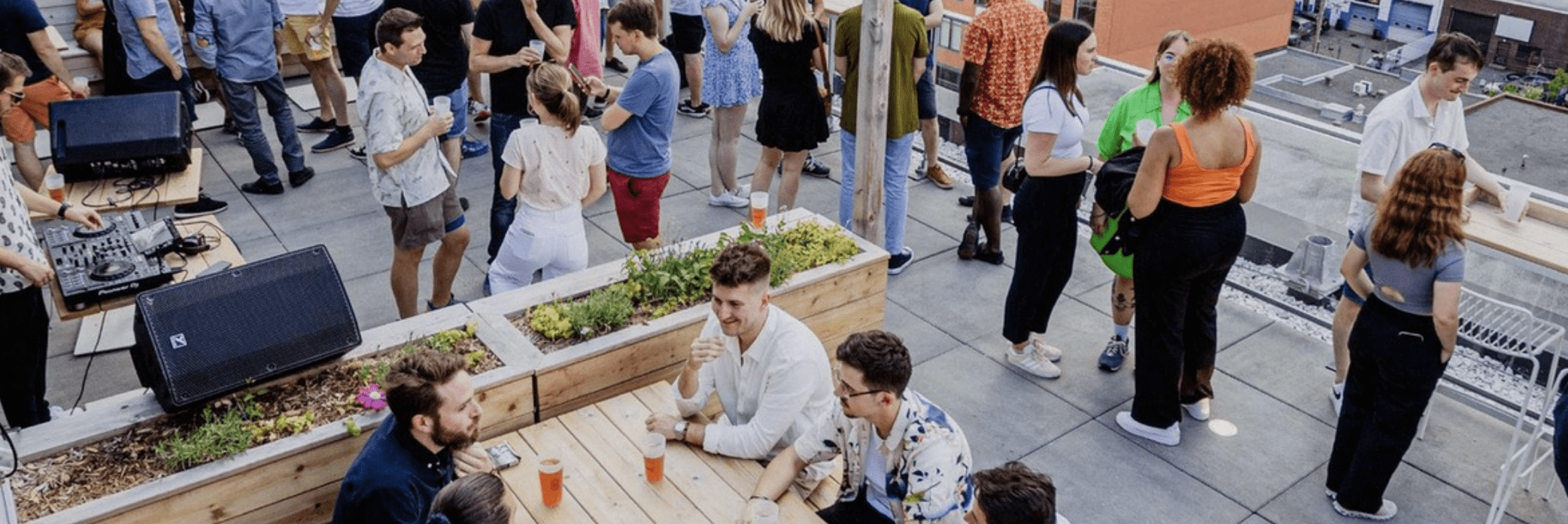
A better experience for participants
The guest experience plays a key role in the success of an event. A venue that is too rigid, too cold, or poorly suited can detract from the overall atmosphere. Conversely, a professional, comfortable, and well-designed environment promotes interaction and engagement.
Flexible offices often offer a more human atmosphere than large, impersonal rooms. The spaces are more user-friendly, traffic flows smoothly, and break areas encourage informal discussions. This creates a climate that is more conducive to networking and collaboration.
Participants feel welcomed into a genuine professional environment, rather than a space strictly reserved for events.
Cost optimization
Renting an external venue for each event can be a significant expense, especially for companies that regularly organize internal or external meetings. In addition to rental costs, there are often additional expenses such as furniture, technical equipment, on-site staff, and cleaning.
By using a flexible space capable of hosting events, some of these expenses can be optimized. The infrastructure is already available, the arrangements are simpler, and certain resources can be shared.
In the long term, this approach reduces costs per event while maintaining a high level of quality.
Strengthening corporate culture
Internal events play a key role in team cohesion and organizational culture. Strategy days, brainstorming workshops, training sessions, or celebrations of success: these moments strengthen bonds between colleagues and give meaning to collective work.
Organizing these events in the same environment where teams usually work creates a natural continuity. Employees feel “at home” in a familiar place that has been transformed for the occasion. This proximity reinforces the sense of belonging and enhances the value of the workspace as a true gathering place.
Flexible offices thus become living spaces, rather than simply functional spaces.
Encourage spontaneous interactions
A good event is not just about its official program. Informal discussions, unexpected encounters, and spontaneous exchanges are often the most rewarding moments.
Flexible offices, with their open spaces, common areas, and more relaxed corners, encourage these natural interactions. Participants can move around freely, isolate themselves to talk, or gather together without excessive constraints.
This fluidity makes events more dynamic and human, which enhances their impact.
High configuration flexibility
Every event is different. A presentation in front of fifty people does not have the same requirements as a small group workshop or a networking cocktail party. Flexible offices allow you to adjust the layout to suit each occasion.
Theater-style seating, classroom layout, work islands, or open space: modular furniture and the diversity of rooms make these transitions possible. This adaptability means you don’t have to look for a new venue for each type of event.
The company thus has an environment capable of keeping pace with its changing event needs.
An accessible professional environment
Location plays a key role in event attendance. A well-located venue that is easily accessible by public transportation or car encourages guests to attend and simplifies organization.
Flexible offices are often located in central, dynamic neighborhoods, close to services, restaurants, and transportation. This accessibility improves the overall experience for participants and enhances the appeal of organized events.
The surrounding environment also contributes to the company’s image and the impression left on guests.
Integrating work and events into a single vision
Modern companies no longer compartmentalize their activities to the same extent. Daily work, training, strategic collaboration, and events complement and influence each other.
Flexible offices fit perfectly into this integrated vision. They allow for a natural transition from one use to another, without interruption. A space can serve as a regular meeting room, then be transformed into a workshop or presentation area.
This continuity enhances organizational efficiency and simplifies overall space management.
A strategic lever for the company’s image
Events are often showcases for an organization. They bring together partners, customers, employees, and sometimes the media. The venue where they take place sends a strong message about the company’s positioning and professionalism.
A well-designed, modern, and versatile flexible office reflects an agile, contemporary, and forward-thinking company. It demonstrates adaptability and a focus on the guest experience.
In this sense, space becomes a strategic communication tool, just like the content of the event itself.
A solution adapted to changing needs
A company’s event needs evolve over time. A growing organization may move from small internal meetings to larger events with partners or clients. Flexible offices can support this progression.
Rather than constantly changing locations, companies can rely on an environment that can adapt to increasingly diverse formats. This continuity simplifies organization and reinforces the consistency of the professional image.
Conclusion
Flexible offices are no longer just modular workspaces. They are becoming true professional platforms capable of hosting a wide variety of events. Thanks to their adaptability, sleek design, simplified logistics, and ability to offer a user-friendly and professional experience, they perfectly meet the new needs of businesses.
By integrating daily work and events into the same environment, organizations gain efficiency, consistency, and impact. Flexible offices are thus emerging as a strategic solution for energizing teams, strengthening corporate culture, and creating memorable moments—without leaving the workplace.