

Creativity has become one of the most sought-after assets in modern businesses. Whether it’s developing new products, solving complex problems, or standing out in a competitive market, teams need to be able to think outside the box. Yet many organizations still underestimate the impact of the workplace on creativity. The physical environment shapes the way people collaborate, discuss, think, and innovate.
Flexible spaces, such as those offered by Espaces Waverly, have gained popularity precisely for this reason. They no longer simply provide a place to work: they have become a strategic tool. When used effectively, they stimulate collective energy, encourage spontaneous exchanges, and promote a form of productivity that goes beyond everyday tasks. They become a driver of creativity.
In this article, we will look at how to transform a flexible space into an environment that inspires, motivates, and encourages teams to innovate.
Why design influences creativity
It has now been proven that the working environment directly influences cognitive processes. Natural light, furniture layout, textures, space circulation, and even noise levels all play a role in how employees generate ideas. A well-designed environment activates areas of the brain linked to curiosity, problem solving, and motivation.
Traditional offices have long favored a linear productivity model: fixed workstations, closed rooms, separate corridors, and a relatively quiet atmosphere. But creativity does not work like administrative work. It thrives on movement, flexibility, interaction, and diversity.
This is why flexible spaces are particularly well suited to creative work. They allow for a natural alternation between moments of concentration, informal exchanges, collective brainstorming, and more technical work.
Using modularity to encourage movement
One of the great advantages of flexible spaces is their modularity. Being able to change the layout of the space according to the team’s needs creates a dynamic atmosphere where ideas flow more freely. A space that can be transformed becomes a space that inspires.
Here are a few ways to use this modularity to boost creativity:
Create areas that encourage different activities
In a flexible space such as Espaces Waverly, it is possible to alternate between:
-
a collaborative work area,
-
a quieter area,
-
closed meeting rooms,
-
an informal lounge,
-
small alcoves for quick exchanges.
Each zone influences a different type of thinking: logical, intuitive, collaborative, or introspective. By giving your team the opportunity to change spaces depending on the task, you encourage a natural rhythm that stimulates creativity.
Encourage physical activity
Creativity increases when people move around. Changing seats, standing up, walking around, or simply changing your environment allows you to reset your brain. This is one of the reasons why ideas often come to us when we are walking or in a different setting. A flexible space allows for this mobility without constraints.
The importance of spontaneous interactions
Unplanned exchanges often give rise to the best ideas. It is not always a structured meeting that sparks inspiration, but rather an informal conversation over coffee or a quick exchange between two colleagues.
Flexible offices encourage this type of interaction in several ways:
Shared areas
In a space like Espaces Waverly, coworking isn’t just about proximity: it’s an opportunity to be exposed to a variety of perspectives. A team of designers might rub shoulders with a fintech startup, a photographer, a marketing entrepreneur, or a strategic consultant. This diversity creates a rare intellectual richness that you won’t find in a closed, homogeneous office.
Unexpected encounters
Comfortable seating, a central coffee corner, well-designed open spaces: all of these encourage people to chat for a few minutes. These informal moments can spark completely new ideas.
The role of design in creativity
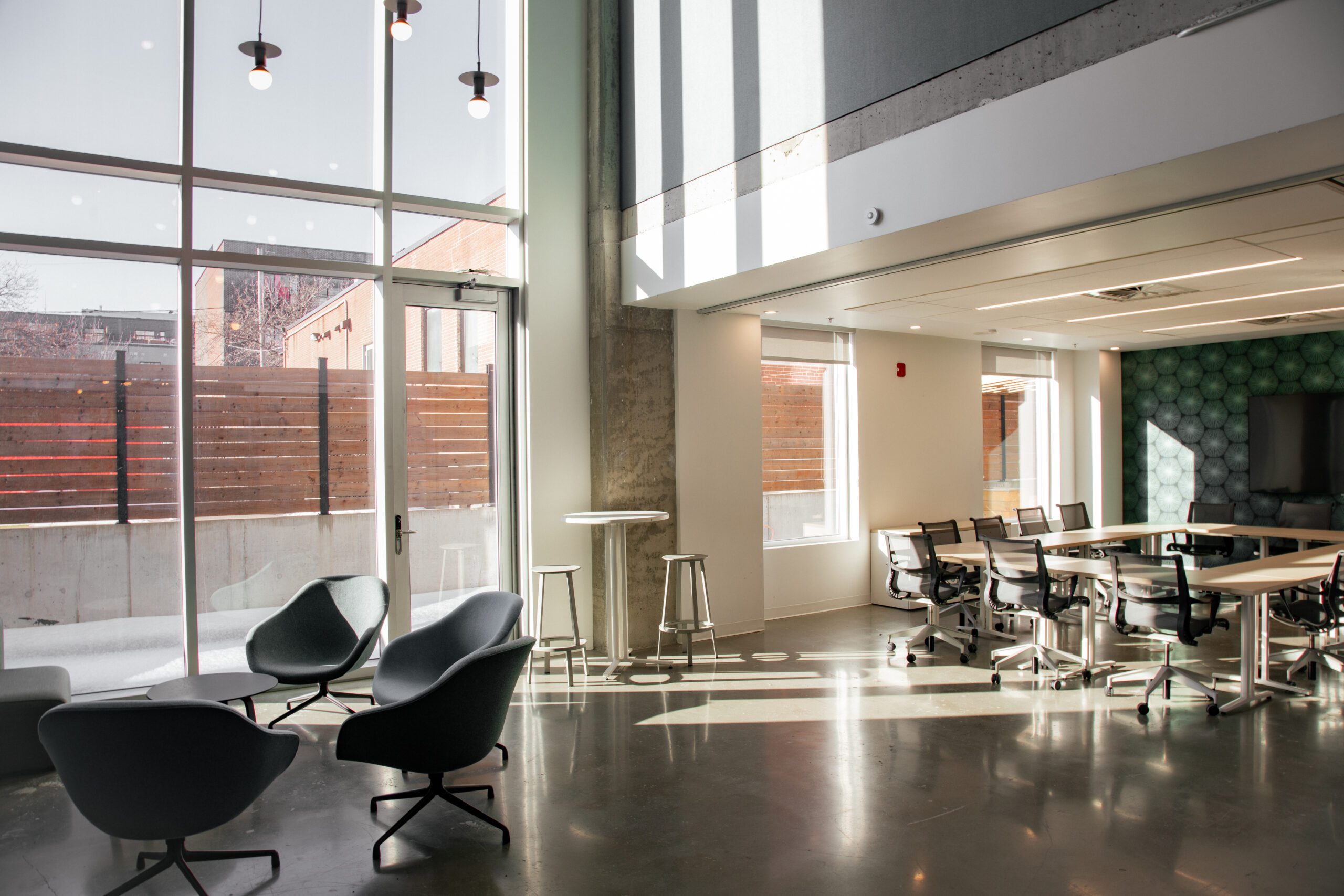
The design of a flexible space is not decorative. It is strategic. Colors, textures, light, and materials directly influence emotions and concentration.
Here’s how good design contributes to creativity:
Natural light
Daylight stimulates mental energy and improves motivation. Spaces such as Espaces Waverly incorporate it into the heart of their design to create a healthy atmosphere conducive to intellectual stimulation.
Natural textures and materials
Materials such as wood, stone, and organic textiles have a calming effect, reduce stress, and promote an open and receptive state of mind. A calm mind is a creative mind.
A balanced color palette
Sober, soothing colors promote concentration, while a few more vibrant touches can encourage expression and boldness.
The absence of visual rigidity
An overly formal design limits creativity. A warm, modern, and elegant environment—like that of Espaces Waverly—creates a setting where teams feel comfortable, inspired, and more inclined to take creative risks.
Organize areas for brainstorming
A flexible space should enable a team to generate ideas quickly and efficiently. This cannot be achieved in a traditional meeting room alone. To stimulate creativity, areas specifically designed for brainstorming must be created.
Accessible writing surfaces
White walls, boards, panels, erasable surfaces: these tools enable teams to illustrate their ideas spontaneously. Visualization makes concepts more concrete and promotes the development of solutions.
Mobile and modular seating
Being able to reorganize a group into a circle, pairs, or small subgroups encourages discussion. The dynamic changes, energy flows, and discussions become more fluid.
A space that does not impose a posture
Sitting, standing, reclining, leaning on a counter: each posture stimulates a different form of energy. A flexible space makes this possible.
Promote concentration as well as collaboration
Creativity doesn’t just come from collaboration. It also needs moments of solitude. Flexible spaces allow you to juggle between the two. A team can spend an hour brainstorming together, then go off individually to develop an idea further.
The importance of quiet spaces
Quiet or semi-quiet areas allow team members to work in depth. It is during these moments that ideas become clearer.
The right to mental breaks
Well-designed relaxation areas allow employees to take a few minutes’ break. The brain often continues to work unconsciously. A break can unlock an idea.
Espaces Waverly naturally integrates these transitions thanks to its fluid and intelligent layout, where each area has a specific role in the dynamics of creativity.
Encouraging a creative culture across space
A flexible space only becomes a driver of creativity if the team embraces a genuine culture of innovation. Space helps, but it doesn’t do everything. Here’s how to strengthen that culture.
Grant permission to test
Teams must feel free to try, experiment, and even make mistakes. A flexible environment automatically conveys this idea. When the space changes, behaviors evolve.
Encourage creative rituals
For example:
-
Encourage creative rituals
-
a standing brainstorming session,
-
brainstorming on a board,
-
a creative coffee at the start of the day,
-
a rotation of work locations.
The flexible space allows for these rituals without effort.
Promoting cross-functional exchanges
By bringing together professionals from different backgrounds in a shared space, Espaces Waverly creates fertile ground for innovative solutions to emerge. Encouraging teams to engage in discussions with other members of the community can enrich their ideas.
Use flexible spaces to support an open mindset
Creativity requires curiosity, letting go, trust, and a non-judgmental environment. The warm and elegant atmosphere of flexible spaces, particularly at Espaces Waverly, creates a climate where team members feel free to express their ideas without fear.
Un environnement sans hiérarchie physique
A flexible space levels out differences in status. No one has a closed office that is more prestigious than others. This encourages:
-
transparency,
-
spontaneous ideas,
-
more natural exchanges.
Une ambiance sans pression
A neat but informal setting reduces stress. Less pressure means more creativity.
How Espaces Waverly is becoming a catalyst for creativity
Espaces Waverly stands out for several reasons that make it an ideal place to stimulate innovation within a team.
A design conceived for well-being and clarity of mind
Natural light, ergonomic furniture, soothing colors, and high-quality materials create an inspiring environment.
Total modularity
The spaces can be rearranged according to the needs of the moment: meetings, creative workshops, individual reflection, or teamwork.
A vibrant community
The presence of a diverse range of professionals encourages the exchange of ideas and unexpected collaborations.
A warm and elegant atmosphere
Teams feel comfortable, confident, ready to share and create.
Conclusion: flexible space as a partner in creativity
A flexible space is not just a place to put your computer. It is a strategic tool for transforming team dynamics, stimulating imagination, and fostering innovation. When used effectively, it becomes a powerful driver of creativity.
Companies that choose a location like Espaces Waverly aren’t just choosing an office: they’re choosing a work experience that supports, inspires, and unleashes the creative potential of their teams. Flexible environments represent the future of modern work, precisely because they place people, collaboration, and inspiration at the heart of their design.