Hybrid working has become the new norm in many companies. Offering the freedom of remote working and the structure of the office, hybrid working promises the best of both worlds. However, behind this appealing idea, organizations are quickly discovering that combining these two realities requires strategic thinking, rigorous logistics, and suitable spaces. The challenge is not just to offer remote days and on-site days: it is to harmonize them in order to derive real value for the company and its employees.
This is where flexible office space is profoundly transforming the way we work. Unlike traditional offices, which rely on fixed workstations and daily attendance, a flexible environment can accommodate fluctuations in occupancy, promote collaboration when needed, and reduce the costs associated with underutilized space. This article explores how to optimize the coexistence of remote working and flexible offices to boost productivity, well-being, and organizational agility.
Understanding the team’s real needs
Before implementing an effective hybrid model, it is necessary to identify the specific needs of the company and its employees: nature of the work, concentration requirements, collaboration needs, presence required for internal culture, team management, etc. Each organization has its own balance, and attempting to copy an external model often leads to friction.
Some teams require frequent in-person tactical meetings; others, focused on analysis or creation, find long periods of remote work highly effective. This is why it is important to consult employees, observe existing dynamics, and establish clear principles: which tasks are best done remotely? Which tasks are better done in the office? How often should teams meet in the same place?
The optimal hybrid model is not fixed. It evolves according to the context, projects, and growth of the company. The flexible office allows for precisely this flexibility.
The role of the flexible office in a hybrid strategy
The flexible office is a strategic tool, not just an alternative to real estate. It addresses the main complexities of hybrid working: variability in the number of people present, the need for meeting rooms adapted to different times, alternating between individual concentration and collaboration, and cost optimization.
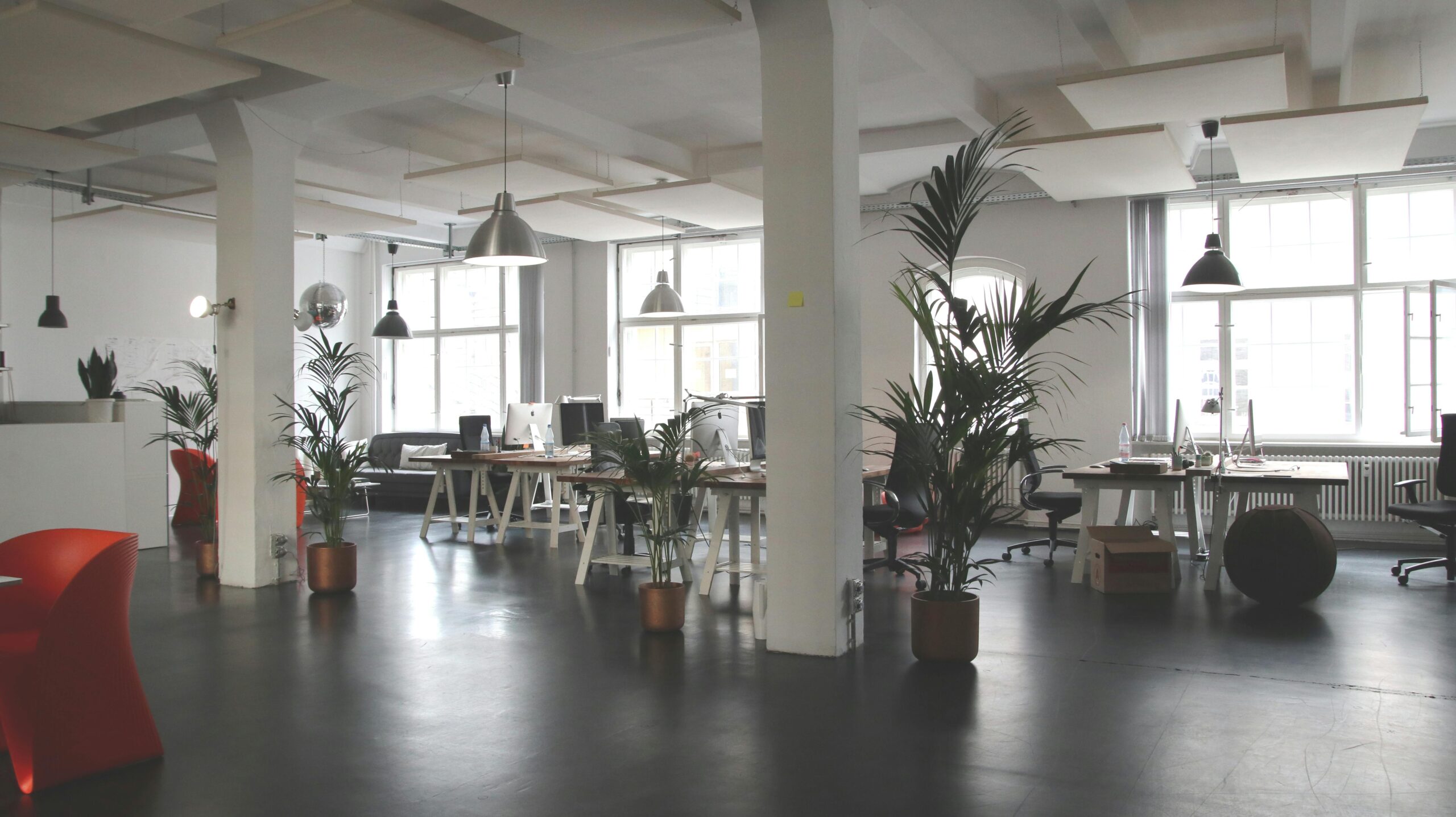
A flexible space offers a variety of areas: unassigned workstations, bookable meeting rooms, collaboration spaces, private booths, informal lounges, and venues for internal events. This diversity perfectly supports the fluctuations of hybrid work: some days require team meetings, while others call for a quiet setting to work efficiently. The company is no longer constrained by a single configuration.
In addition, flexible space eliminates wasted space. With occupancy rates often fluctuating between 30% and 70% in hybrid offices, depending on the day and the team, maintaining a traditional lease often becomes costly and inefficient. Flexible space allows companies to pay for what they actually use, while offering a modern and well-equipped environment.
Create a clear and fair policy
A hybrid model cannot function without an explicit policy. It must cover not only days of attendance, but also how to use the space, access to rooms, rules for collaboration, expectations of managers, and performance standards.
A few essential elements to define:
– Minimum frequency of on-site presence
– Situations where office presence is mandatory (strategic meetings, project start-up periods, training)
– Types of spaces to be used as needed
– Reservation rules
– Opening hours
– Employee responsibilities (communication, online punctuality, availability)
– The role of managers in hybrid coordination
A clear policy creates a sense of fairness and reduces confusion. It also helps avoid extremes: an empty office on some days, then overloaded the next.
Ensure smooth synchronization between teams
Hybrid working becomes effective when teams manage to synchronize efficiently, whether they are working remotely or on-site. This requires structured communication and regular rituals.
Hybrid meetings should be designed to prevent remote employees from feeling like they are second-class citizens. Good audio-visual equipment, high-quality screens, rules for speaking, and a designated facilitator help ensure a fair environment for everyone.
Many companies adopt a system of “team days,” where everyone meets at the office on the same day. This helps strengthen bonds, speed up projects, and provide a common direction. On other days, employees divide their telework time according to their individual needs.
Flexible spaces facilitate this: they can accommodate groups, organize workshops, provide collaborative work areas, and thus support sustainable synchronization.
Encourage collaboration without neglecting concentration
One of the pitfalls of hybrid working is to view the office solely as a place for collaboration. However, working in person often offers a higher quality of concentration than working from home, especially for those who live in small homes or are surrounded by distractions.
The flexible office has the advantage of offering several types of spaces: quiet areas for focused work, closed offices for confidential calls, open spaces for quick exchanges, and meeting rooms for structured discussions. This diversity allows employees to choose the environment that maximizes their efficiency depending on the task at hand.
Offering this variety is essential to prevent the office from becoming a chaotic place where collaboration takes precedence over everything else. True hybrid success depends on striking a balance between interaction and concentration.
Using technology as the backbone of the hybrid model
A high-performance hybrid model is supported by fluid, intuitive, and unified technological tools. Technology becomes a bridge between the two worlds.
Essentials include:
– Room and workstation booking platform
– Collaborative tools (Google Workspace, Notion, Slack, etc.)
– Digital attendance management
– High-quality videoconferencing solutions
– Centralized archiving to prevent information loss
– Project and task management systems
A robust technological infrastructure helps maintain continuity, regardless of where people are working. Without it, teams become scattered, projects slow down, and communications become fragmented.

Redefining corporate culture in a hybrid context
Corporate culture is no longer built solely around a physical space. In a hybrid model, it spreads through shared moments, rituals, lived values, and human interactions—whether virtual or in person.
To strengthen cohesion, several levers exist:
– Organize regular in-person collaboration days
– Plan team-building activities or happy hours in adaptable spaces
– Encourage daily or weekly check-ins
– Celebrate collective achievements
– Use the flexible office as a place for meaningful encounters
A space like Espaces Waverly contributes to this culture by offering a welcoming, inspiring, and versatile environment where teams can come together without rigidity.
Empowering managers
Managers play a crucial role in the success of hybrid working. They must know how to lead dispersed teams, maintain cohesion, ensure that employees have the right tools, and create an atmosphere of trust.
Their responsibilities are changing:
– Encourage autonomy while providing a framework
– Ensure transparent communication
– Manage performance expectations
– Prevent isolation
– Coordinate office attendance
– Help employees better manage their workload
Managers are the primary architects of the hybrid workday. Their support determines whether the model becomes a success or a hindrance.
Maximizing the employee experience
Hybrid work should improve employees’ professional and personal lives, not complicate their organization. This requires tangible initiatives:
– Ergonomic tools at home
– Easy access to workspaces when the home is not ideal
– Flexible working hours
– Simplified services offered at the office (parking, sports equipment, coffee, security, etc.)
– Relaxation or breathing areas
A model that takes well-being into account attracts and retains talent. Employees no longer come to the office out of obligation, but by choice—which profoundly changes the dynamic.
The future of hybrid work
The companies that are most successful in this hybrid model are those that embrace change as an ongoing process. The model must be regularly reevaluated, adjusted, and improved. Needs evolve, teams change, projects vary, and spaces must keep pace.
The flexible office is a key part of this evolution. It enables continuous adaptation, greater profitability, an enhanced employee experience, and an environment conducive to both collaboration and concentration. Hybrid working is not just a trend: it is a profound transformation in the way teams operate, innovate, and connect.
By mastering this coexistence between remote working and flexibility, companies are entering a new era: one in which mobility, trust, and collective intelligence are becoming the pillars of a sustainable and high-performing organization.